

Upskilling is the practice of teaching employees new skills to better perform the duties of their current job occupations. According to the Emeritus 2021 Global Career Impact Survey, management and leadership ranked second (34%) on the list of the most critical upskilling needs. An estimated 46 percent of employees surveyed believe their current skill set will become irrelevant by 2024. Yet, 61% of companies offer no leadership training, according to a LinkedIn Learning report. Without adequate upskilling to meet the changing demands of their jobs, employees face excessive job stress and feel that their mental health has suffered. Investing in upskilling, on the other hand, boosts morale, improves employee retention, improves customer satisfaction, and attracts new talent.
What is experiential learning in the workplace?
A common upskilling challenge is a lack of experiential learning. Unlike passive learning models where learners listen to presentations, experiential learning allows learners to participate in hands-on learning experiences by performing the task or skill at hand. Also known as learning in the flow of work, experiential learning is an opportunity to revolutionize how companies train their employees and develop leaders from within. In addition to the benefits of upskilling mentioned above, experiential learning helps to improve organizational performance in the following ways:
- Develops organizational agility, i.e. the capacity to adapt to new situations
- Helps to apply new skills on the job by bridging the gap between theory and practice
- Creates a safe learning environment to encourage experimentation and trial without fear of failure
- Improves ROI and likelihood of success for the company as a whole
- Enables for accurate assessment of skills
Scenarios
Scenarios provide a safe learning environment to explore situations and encourage learning while doing. Exercises using personas can provide a reason to use the learning material to solve problems. Beyond this traditional approach, an alternative means of using scenarios is to encourage the learner to explore situations that are particularly meaningful to them. By incorporating critical and necessary elements of work in the learning environment, learners have strong incentive to apply the new information learned to situations that are highly relevant to them live and in real time. Other examples of scenarios might also help to expand the strategic thinking tools applied to situations as well. These thinking-tools-based scenarios include the following:
- Best Case/Worse Case/Expected Case
- Decision Points Mapping
- Decision making frameworks to evaluate ideas for addressing situations
- The Cost of Doing Nothing
Lessons Learned & Case Studies
Learning from the past (i.e., case studies), examples crafted from principles, and learning from the experiences of others (e.g., case studies) are a great use of corporate training. People learn better from examples than from generalities. The use of scenarios helps teams to not only avoid potential pitfalls but also to see experimentation as a way to grow and to gain valuable insight.
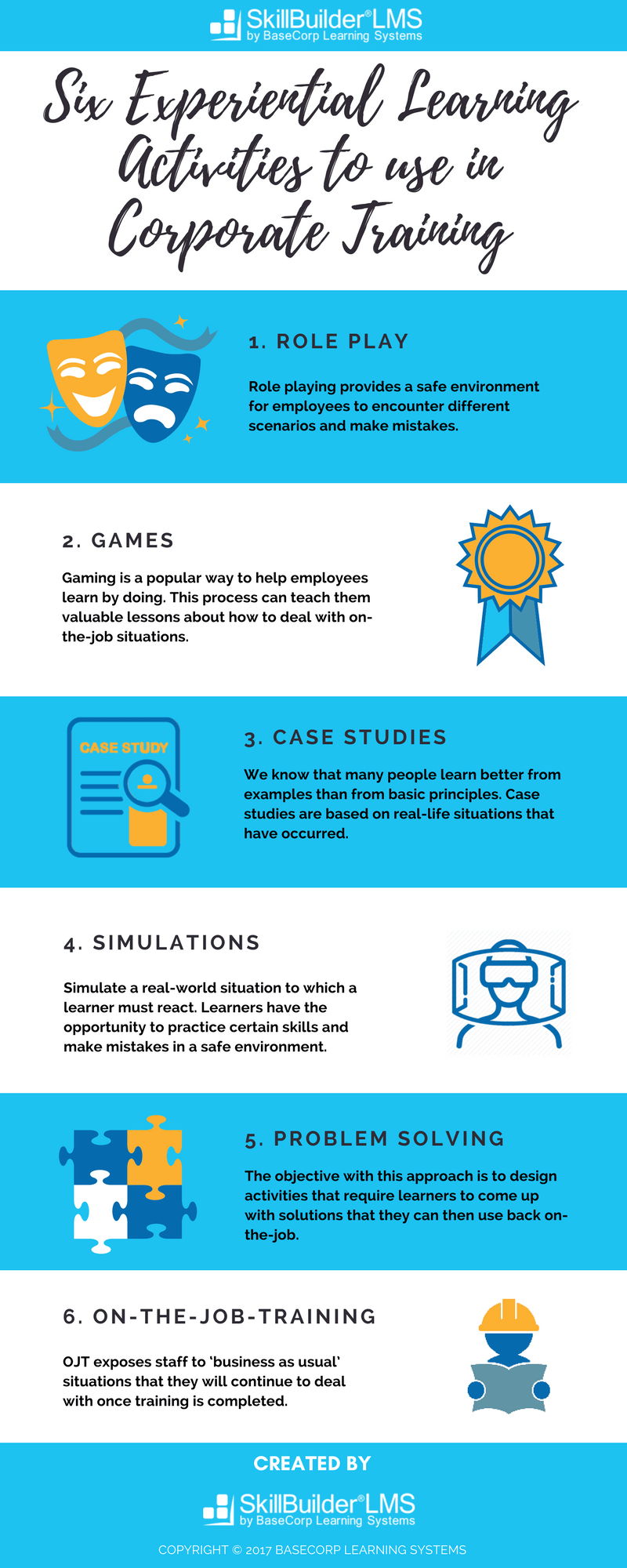
Source: eLearning Infographics. (2017, November 24). Six Experiential Learning Activities to Use in Corporate Training Infographic. https://elearninginfographics.com/six-experiential-learning-activities-corporate-training-infographic/
Interactive Simulations
Interactive simulations and games can help learners build a Kinesthetic connection, that is an automatic reflex response to stimuli, by engaging with the content. Rather than just showing learners how to use software, for example, they can get experience with it themselves. Simulations can help learners use the controls and see the outcomes. Alternatively, in stressful or critical situations where recall is key, actions can be trained repeatedly until mastered, like how to manufacture a medical device. This type of training can also help learners to receive first hand experience remotely or in a safe environment, like the proper use of safety equipment.
Workshops
In the workplace, much of the problem solving is done in within cross functional teams. Taking in the perspectives of the different roles helps to ensure that the learning outcomes are well vetted. But, these are times when a training intervention is necessary to draw attention to and focus on specific areas. So, in these cases, workshops that center around structured problem solving for a cross functional team is likely to be a more authentic, relevant, and effective learning experience. Furthermore, this facilitated learning experience is likely to yield more unexpected insights than a solitary problem solving activity in the working world.
Professional Development Projects
Experiential learning evolving from Personal Development projects is also likely to lead to highly effective learning experiences. These projects can take on any shape, depending on the performance gaps identified. Learners can commit to providing a presentation to leadership on a topic of interest by a certain date for further incentive.
On the Job Training
Last but not least, a great way to learn job-related instruction is to apply it on the job. New expectation and news form the marketplace will ideally trigger the training to be applied in order to create a response. Trying out a new skill on the job is the ultimate experiential learning experience.
Consider incorporating these experiential learning experiences into your leadership training. And, if you are seeking to build a leadership program around experiential learning or would like to be trained, please feel free to reach out to me.
Author Information

Felicia Littlejohn, Ph.D., is Learning and Development (L&D) professional, leadership coach, and former commercial business leader who empowers others to achieve their goals. Her work in leadership development, coaching, and strategy consulting has helped businesses, teams, and professionals to upskill, cultivate leadership potential, enhance performance, and overcome growth hurdles. Felicia is a Certified Professional Coach (C.P.C.) who holds a Ph.D. in Engineering, an M.B.A. in Marketing, and is currently pursuing an M.Ed. in Instructional Design.